



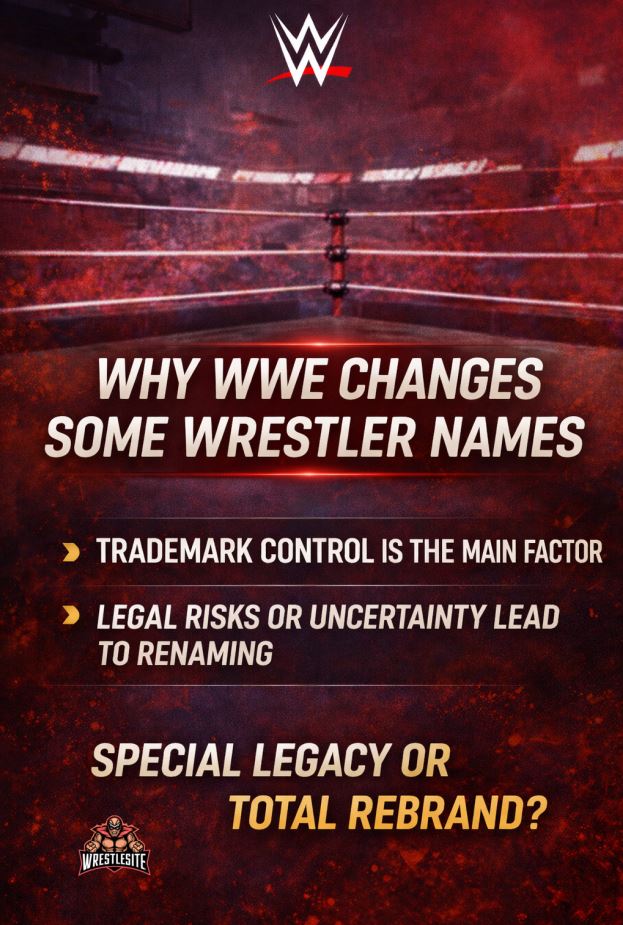
Trademark control plays the biggest role behind name changes
Summary
– WWE name decisions are driven primarily by trademark ownership
– Even long-used indie names are not automatically approved
– Internal misunderstandings have led to inconsistent name decisions
WWE’s approach to wrestler names often appears inconsistent to fans, but the reasoning behind it is rooted in business rather than creativity. According to insights shared during a Fightful Select Q&A, the determining factor usually comes down to trademark control. WWE prioritizes whether it believes it can legally own and protect a name.
Sean Ross Sapp explained that WWE evaluates each name based on potential rights acquisition. If the company believes it can secure ownership, the wrestler is more likely to keep their established identity. If not, a rebrand is often seen as the safer option.
The process is not without flaws. Sapp pointed to a recent internal misunderstanding involving Ricky Starks as an example of how confusion can arise. Despite Starks having previously wrestled under that name in WWE-related appearances, there was uncertainty within the company about who actually held the trademark.
That confusion highlights the imperfect nature of WWE’s system. Prior usage, fan recognition, and career history do not guarantee approval. Even names that feel established can be changed if WWE believes there is a legal risk involved.
Ultimately, WWE’s goal is to maintain control over branding, merchandise, and licensing. Name changes are often preventative rather than personal. For incoming wrestlers, the outcome remains unpredictable, with branding decisions hinging on legal clarity rather than legacy.